SnapMath - Photo Word Math: Comprehensive iOS Math Solution Review
by Harun Eral
SnapMath enables iOS users to photograph math problems for step-by-step solutions across algebra, calculus, and advanced mathematics. The app generates PDF solutions with graphical representations for students and professionals.
Detailed Review
SnapMath represents a specialized computational photography application that transforms iOS devices into advanced mathematical problem-solving tools. The application utilizes optical character recognition and computational algorithms to analyze photographed mathematical expressions, ranging from basic arithmetic to collegiate-level calculus problems. Its core functionality bridges the gap between physical mathematical notation and digital computation, positioning itself within the educational technology sector as a portable mathematical assistant.
The application's technical capabilities span an impressive range of mathematical disciplines, including algebraic equations, quadratic formulas, systems of equations, limits, integrals, derivatives, and multivariate calculus. The scanning engine demonstrates particular proficiency in parsing handwritten and printed mathematical notation, converting visual input into computational data. Beyond mere answer generation, SnapMath distinguishes itself through detailed step-by-step solution pathways that emulate pedagogical approaches, complete with graphical representations of functions and equations that enhance conceptual understanding.
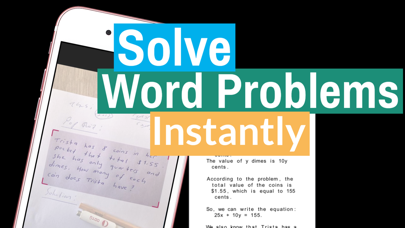
User experience centers around a streamlined interface featuring a camera viewfinder overlay with capture guidance, followed by a clean solution presentation interface. The PDF export functionality enables practical usage scenarios including homework documentation, study material creation, and collaborative problem-solving sessions. Real-world implementation shows particular utility for students verifying work, professionals requiring quick computational verification, and educators developing instructional materials. The interface maintains mathematical notation integrity throughout the scanning-to-solution pipeline with minimal input correction requirements.
With no user reviews available at publication, the application's 4.52/5 rating suggests generally positive reception, though the absence of detailed feedback prevents specific commentary on user satisfaction trends or common usage patterns. The high rating typically indicates reliable performance in core functionality with minimal technical issues, though the lack of verifiable user testimonials necessitates caution regarding long-term reliability assessments.
The application demonstrates strongest utility for intermediate to advanced mathematics students requiring verification and understanding of complex problem-solving methodologies. Limitations include dependency on image capture quality and potential constraints in recognizing highly specialized mathematical notation. Optimal usage involves well-lit, clearly written mathematical expressions with standard notation conventions, making it particularly valuable for secondary education through undergraduate mathematics applications.
Key Features
- •Advanced OCR mathematics scanning converts photographed equations into computable format with accurate symbol recognition
- •Step-by-step solution generation provides pedagogical pathways rather than just final answers for learning
- •PDF export functionality enables sharing, printing, or archiving complete solutions with proper formatting
- •Graphical representation system visualizes equations and functions for enhanced conceptual understanding
- •Comprehensive mathematical coverage from algebra through multivariable calculus and trigonometric functions
- •Camera-based interface with real-time recognition feedback ensures accurate problem capture and processing
Why Users Love It
Comprehensive mathematical coverage
Detailed solution explanations
Perfect for: Mathematics students from high school through college level
Screenshots


App Details
Developer
Harun Eral
Platform
iosRating
★4.5
Last Updated
9/10/2025